Description
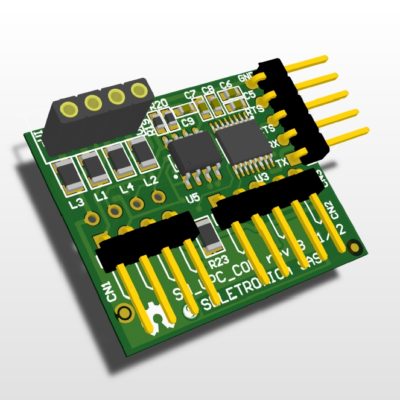
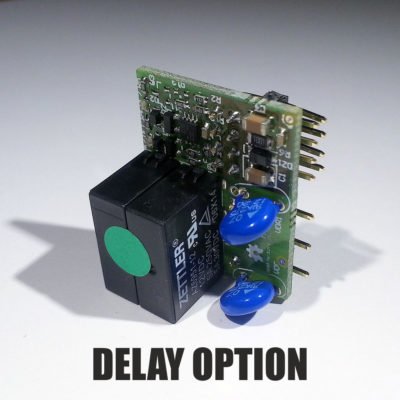
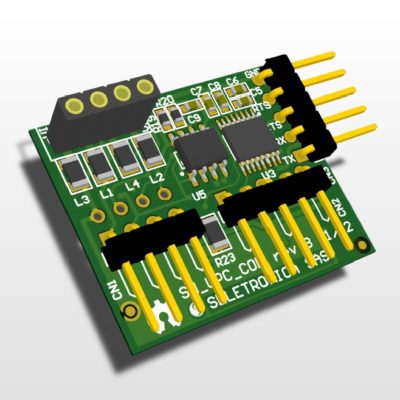
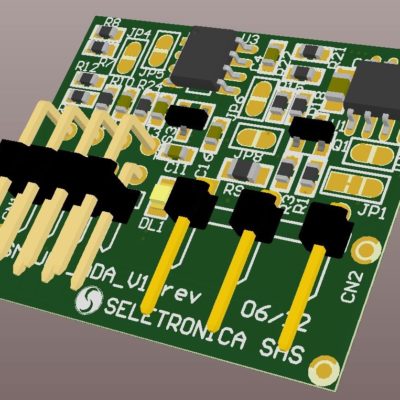
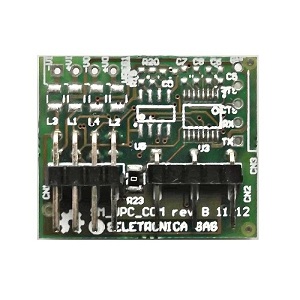
This SnipCard can handle two 1-Wire channels or one I2CBUS channel. The card is designed to fit specific components for two opto-isolated outputs (optional mode).
The 1-Wire devices made by Dallas Semiconductor, of which the Seletronica uses the iButton buttons as personal identification device, provide a wide range of products (temperature sensors, actuators, identification devices with unique code etc. …). All these devices can be connected to the same serial bus (two-wire), which allows to easily extend the number of sensors for data acquisition.
1-Wire / I2C bus base board connections
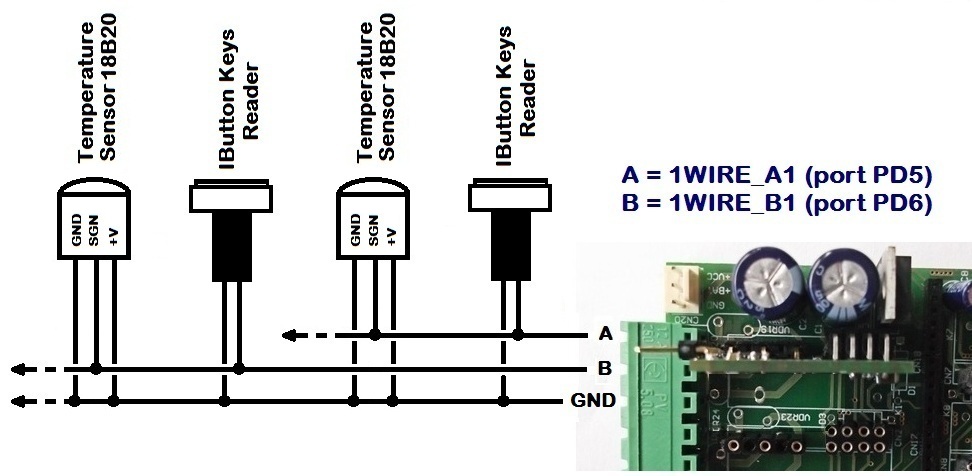
1WIRE I2CBUS SnipCard connections
Technical specifications
- OUTPUT A:
- 1-WIRE 1 (or SCL)
- OUTPUT B:
- 1-WIRE 2 (or SDA)
- COM PLUG:
- GND
1-Wire Code example
#include <Archiduino.h>
#include <pins_archiduino.h>
#include <DallasTemperature.h>
#include <OneWire.h>
#include <LiquidCrystal.h>
#include <ArchiduinoLcd.h>
#include <LiquidCrystal_I2C.h>
#include <Wire.h>

#define ONE_WIRE_BUS M8B
OneWire oneWire(ONE_WIRE_BUS);
DallasTemperature sensors(&oneWire);

ArchiduinoLcd_PCF lcd;        // set the LCD address to 0x20 for a 16 chars and 2 line display

int KeyboardPin = PB4;        // select the input pin of lcd-keyboard
int KeyboardValue;            // variable to store the value coming from the keyboard
int ledPin = LED_RUN;         // select the pin for the LED
bool ledStatus;
int rele = RELE_11;
int setupStatus = 0;          // flag to 1 if setup mode is active
float setTemp = 30;
float readTemp = 0;

void setup() {

  delay(200);
  lcd.init();                      // initialize the lcd
  lcd.begin(16, 2);                // initialize lcd and keyboard
  lcd.clear();

  sensors.begin();

  lcd.backlight();
  lcd.print("   ARCHIDUINO   ");
  lcd.setCursor(0, 1);
  lcd.print("  TEST DS18B20   ");
  delay(1000);
  lcd.clear();

  pinModeEx(rele, OUTPUT);
  pinMode(M7A, OUTPUT);
  pinMode(M7B, OUTPUT);

}


void loop(void) {

  readKey();

  if (setupStatus == 0) {
    readTemp = sensors.getTempCByIndex(0);
    sensors.requestTemperatures();
    lcd.setCursor(0, 0);
    lcd.print("PROBE: ");
    lcd.print (readTemp, 1);
    lcd.print( (char) 223 );   // Degree symbol '°'
    lcd.print ("C");
  }

  stampaSoglia();

  if (readTemp >= setTemp) {
    digitalWriteEx(rele, LOW);
    digitalWrite(M7A, HIGH);
    lcd.ledOff();
  }else{
    digitalWriteEx(rele, HIGH);
    digitalWrite(M7A, LOW);
   lcd.ledOn();
  }

}

void readKey() {

  KeyboardValue = analogRead(KeyboardPin);

  if(lcd.IsButton1Pressed() && setupStatus == 1){
    lcd.setCursor(0,0);
    lcd.print ("SETUP COMPLETE  ");
    delay(500);
    lcd.setCursor(0,0);
    lcd.print ("              ");
    setupStatus = 0;
  }

  if(lcd.IsButton2Pressed() && setupStatus == 1){
    setTemp -= 0.1;
    stampaSoglia();
    delay(100);
  }

  if(lcd.IsButton3Pressed() && setupStatus == 1){
    setTemp += 0.1;
    stampaSoglia();
    delay(40);
  }

  if(lcd.IsButton4Pressed() && setupStatus == 0){  // ENTERING SETUP
    delay(500);
    setupStatus = 1;
    lcd.clear();
    lcd.setCursor(0,0);
    lcd.print ("SETUP");
    stampaSoglia();
    delay(40);
  }

}

void stampaSoglia() {
    lcd.setCursor(0, 1);
    lcd.print("THRES. : ");
    lcd.print (setTemp, 1);
    lcd.print( (char) 223 );   // Degree symbol '°'
    lcd.print ("C");
}

void ledBlink() {

  if (ledStatus==0)
  {
    ledStatus = 1;
    lcd.ledOn();      //led run on
  }
  else
  {
    ledStatus = 0;
    lcd.ledOff();    //led run off
  }
  delay(100);

}
Attachments
-

-
Title: SM_UPC_COM_V1_Schematic 1-Wire (834 clicks)
Caption: 1WIRE / I2C SnipCard - Schematic
Filename: sm_upc_com_v1_schematic-1-wire.pdf
Size: 287 KB